Wednesday, April 23, 2008

Drink with Damien! an Omen Drinking Game


The Omen Drinking Game:

Play as your favorite character:

Beginner Drunk – Kathy Thorn (Lee Remnick)
Intermediate Drunk – Robert Thorn (Gregory Peck)
Advanced Drunk – Damien Thorn (Harvey Stephens)
Guilty Drunk – Priest (Tommy Duggan)

Suggested Drinks

For shots: try one of the classic 3 (make it double shots for the classic 666) – vodka, rum, or whiskey
For a cocktail: try a Bloody Mary, gives delicious suggestions of gore and religion.

The Directions are extremely simple for those who are stupid drunks.

-Those playing as Kathy take a shot/sip every time the camera has a shot of her “scared” eyes
-Those playing as Robert take a shot/sip every time Gregory Peck gives the “stern yet worried” eyes.
-Those playing as Damien take a shot/sip every time the camera has a creepy shot of his “evil” eyes.
-Those playing as the Priest should take a shot every time the camera shows his “crazed” eyes, immediately after shot perform the “father, son and holy spirit”.

Happy Drinking!

Paradise Lost drinking game


(posted by Professor Peg for Billy Chew)


Okay, so I thought I'd give us a little drinking game to make the hopelessly bleak Paradise Lost a little more palatable (or a little more bleak - alcohol being a depressant).

TAKE 1 DRINK WHEN:

Someone invokes God to rain vengeance down upon Jesse Misskelley
Someone invokes God to punish Jason Baldwin in the pits of Hell
Someone invokes God to torture Damien Echols with fire and brimstone
Someone invokes God to help them forgive

TAKE 2 DRINKS WHEN:

Someone in the police department admits to losing a piece of evidence
Someone in the police department mentions how agreeable Jesse Misskelley was during his interrogation
Someone in the police department repeats a question asked to them with their eyebrows raised, their eyes wide, and their jaw slack like an eight year-old asked who kicked the dog
Someone in the police department congratules themself on their police work

TAKE 3 DRINKS WHEN:

You think to yourself "John Mark Byers is fucking crazy."
You think to yourself "I wonder if John Mark Byers murdered the...naaaaah!"
You think to yourself "Good Lord. I wonder if John Mark Byers really did it. Maybe the documentarians are just painting him that way..."
You think to yourself "Well, it's understandable that the three boys were convicted. Everyone in that room deserves a little slack - all of them being the children of in-bred Cthulhu fish people unaccustomed to the nature of logic and reality."

TAKE 4 DRINKS WHEN:

You are ready to die of alcohol poisoning and leave this horrific planet for good and join the Dark Lord himself.

Gabriel the new Lucifer?


One of my favorite movies is The Prophecy, starring Christopher Walken as Gabriel. Released in 1995, its one of the first movies I know that start referring to the Archangel Gabriel as the nemesis of man.
The idea here is that Gabriel gets sick of man not taking full advantage of there free will and scorning God for it. After all thats happened with the war against heaven and hell, people seem to be knowingly choosing hell. Gabriel decides waiting for the apocalypse just doesn't cut it for him, and its time he quick starts it. The Archangel Gabriel has fallen from grace and is now here to destroy us.
Beyond that though, the plot thickens. While this is causing another heavenly civil war similar to the fall of Lucifer, of those with Gabriel and those still loyal to man and God, there's also a third side. Lucifer (played amazingly by Viggo Mortensen) doesn't want Gabriel to win, "because two hells is one hell too many, and I can't have that." So, grudgingly, Lucifer helps man to overthrow Gabriel.
One movie doing this, not a big deal. But Since that, multiple other movies have come out with somewhat similar ideas. Most accessible are the sequels of the prophecy, Constantine, and Dogma. Dogma is a little different seeing as the devil plays less of a role, although we do get a sense that he's not happy about what Gabriel is doing. Constantine on the other hand takes the plot straight forward.

I think the movie has interesting implication. Gabriel and Lucifer for a long time have been symbols. Gabriel is a symbol for Christianity, or perhaps organized religion in its whole for the western world, and Lucifer representing science. With that in mind, Gabriel is betraying man, sick and tired of us and just wants to end us. In that light, its saying organized religion has betrayed us, has led us astray and left us to die. With growing bedgrudgement against religion, its hard not to think thats what the creators were saying with The Prophecy . But there's a second statement surrounding Lucifer's character. Lucifer tell us he isn't helping us because he wants to, "Y'see, I'm not here to help you and the little bitch because I love you or because I care for you,"but because he simply can't allow there to be more out there than him. If Lucifer is science, what does that say about science? Science is amoral, it doesn't give a damn what happens to us or if we understand us. It won't be here for our emotions or lack of security, it simply is there. We can use it, and it can use us...but thats all we'll get, abuse back and forth.

I find the statement hidden in the movie something amazing to think about. While Lucifer and Gabriel are the most obvious thinks pointing to this idea, the two main humans are also battling their own ideas of faith and it further presses this idea. At the least, its just an awesome movie, and Viggo Mortensen gives perhaps the best performance of Lucifer ever. Definitely an amazing movie.

*What does this have to do about the Peg Aloi article we had to read? Nothing. BUT, this was going to be my final paper. That didn't work out. Instead my final paper became a response to the article, and as such I bumped this idea to a blog post instead, just in case I don't already have 5+ posts.

Monday, April 21, 2008

A Little Dab’ll do you in


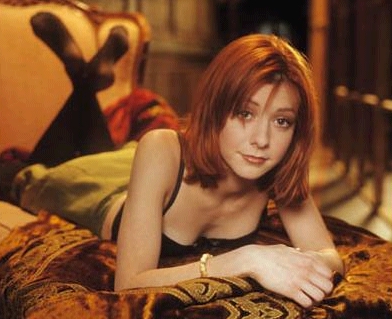
Teenage dabbling in witchcraft is something most of us would probably consider a harmless activity. Light some candles, burn some incense, pray to the Goddess. All in fun and games, unless you’re Willow Rosenburg.
I’m an avid Buffy the Vampire Slayer fan, and I’ve always thought of the case of Willow’s witchcraft to be a strange one. It started out fine; Willow was a more or less competent dabbler. The show never presented her fascination as bad or evil. Given the premise of the show, it would have been odd for them to do so.
Which leads me to season 6 of Buffy. Inexplicably, witchcraft became a bizarre metaphor for drug abuse and addiction. I consider it to be right up there among the worst misplaces drug allegories on TV.(anyone else remember “I’m so excited! I’m so excited! I’m so….. scared!”)
What makes this case all the more strange is that the show is basically putting witchcraft in a bad light. It makes it seem that practicing witchcraft is dangerous. Willow, probably the show’s sweetest character, is transformed into a crazy evil villain, bent on destroying the world.
Up until this point, the show had basically been promoting some forms of witchcraft. Willow’s magic managed to save the day using her powers. Now she’s addicted?
The witchcraft in Buffy had a clearly feminist bent. The show itself was bent on female empowerment. Witchcraft itself seems to be far more female friendly than other types of accepted religions. It prominently worships female deities as equal to, or even superior to, male deities. All this has made it an attractive alternative for some of the feminist movement.
Which makes this season 6 plotline more out of place. Not only does Willow go crazy, but it is only Xander, her male best friend, who can save them all. If you look at, it almost seems like an anti-feminist statement. Willow “overdoses” on empowering herself, and must be kept in check by the show’s resident man.
This scene is similar to the scene in The Craft when Fairuza Balk goes crazy on power. If the practice of witchcraft really does represent a kind of female empowerment, then what kinds of messages are we sending by showing these dabblers going crazy because of their dabblings? Are these movies really an invitation to witchcraft, or a slam against empowerment?
Perhaps I read too much into the situation, but it is something interesting to consider.

Sunday, April 20, 2008


Faruiza Balk, depicted above, wasted out of her fucking cauldron.

The Craft Drinking Games

My game has three stages, because if I learned one thing from the movie, self-restrain is necessary and its never to good to get drunk (with power).

If you're a teenage dabbler, only drink when:

Skeet Ulrich says anything that makes him sound remotely smart (he is dreamy though... sigh).
Marsha Brady isn't a total bitch.
You remember that anyone in this movie besides Faruiza Balk has family members.

If you're an experienced member of a coven of four, you drink when:

A homeless man inexplicably appears and then dissapears with no explanation. Take a shot if the homeless man mutters incoherently about a snake (don't all homeless men mumble incoherently about their snakes?)
Faruiza Balk's mom downs a drink, which is whenever she's on screen.
You spot an upside down cross worn as jewelry.

If you're a natural witch, drink when:

People get what's comin' to 'em, but with magic.
Someone transforms into someone else, Mission Impossible style but with magic.
Poorly dated CGI effects happen (if it's a bad CGI effect and a transformation spell rolled into one, drink your whole bottle).

The End
Now your drunk, and it's all thanks to Professor Aloi! And also magic.

The Decline of Witches in TV and Film


Through the 90's, film and television's depictions of witches transformed a great deal of well worn perceptions. No longer were witches green-skinned, hair-moled, pointy-hated hags, but sexy, vibrant, young women. As Professor Aloi's essay makes clear, The Craft and several other popular texts created role models for young teenage girls. In many ways, the power fantasies inherent in superheroes for teenage males thrived in relation to witchcraft and teen girls. Giving a sense of empowerment to a demographic whose voice can many times be largely ignored, the witchcraft explosion served as a welcome tool in teenage development. Wiccan practice for many teens influenced by such texts as The Craft, or Charmed was probably in many cases a form of rebellion. It was stronger rebellion for girls growing up in conservative regions of the country. As stated by Christian writer, Steve Wohlberg, Witchcraft had gone mainstream (this is this guy's site http://www.whitehorsemedia.com/articles/details.cfm?art=20). Kids growing up in the nineties undoubtedly felt a close bond with their television witch counterparts, as evidenced by the intense fanbase of shows like Buffy and the ilk.


But now, for the most part, depictions of witches has all but dried up. As a generation grew up and went to college, a new set filled the highschools and the demographics. The shows changed from following the adventures of the overly burdened Buffy and Willow, to the exploits of rich and shallow teens of The O.C. Shows like The Hills and My Super Sweet Sixteen have marked a change in programming aimed at teenage girls. Could a change in values over a scant few years be the reason the witches are currently absent from television and film of late? I'm not really sure, and to be honest, this blog entry is more of "outloud thinking" than anything else.


The metaphor for female empowerment and witchcraft is strong indeed, and the media tapped into it to target a particular demgraphic. It seems like now, teenage girls have flocked less to the strong female role models of Willow and Tara and fed into the cell-phoniness of celebrities like Paris Hilton and the stars of The Hills. From witches to bitches, I guess. With the Harry Potter's books all wrapped up, and the last of the movies on the way, the popularity of wiccan and witchcraft may have waned, which is a shame, considering the fact that, despite Christian outcrying of occult depictions, these media works have had overall a positive impact on the teens that have connected to them.

The Colored Mixed Drink Drinking Game

Requirements: Hard alcohols and mixers of your choice. Suggested: Vodka, Gin, Rum, Tequila, Coke or Sprite, and Sweet and Sour Mix.
The movie Masque of the Red Death.
The ability to remember color coding.
And of course, shot glasses and cups.

Pre-watching: However you want, color code each of the drinks with any of the 6 major colors.

Alright, start the movie!
For every scene, find the [b]major[/b] colors in the scene...and mix the drink together, and drink!

If you are using mostly hard alcohols, everyone doing this every scene will equate to mass suicide, and as such you probably want 3 people minimum, and one person has to make the drink, one person has to drink said drink, and another person attempts to identify the major colors.

Not only are you getting drunk fast, you get to make new mixed drinks and try to remember them in the morning. You may want to choose your colors so that you know the last drink will finish anyone off, and my suggested drinks will make the last few scenes be nothing but AMF's.